SILVERBACK MARKETING PRESENTS

AI READINESS KIT

A skill that tells exactly who you are, before they guess wrong.

16 FILES7 CATEGORIESDEPLOY READY
THE NEW FRONT DOOR

AI is where research starts. Is your brand ready?

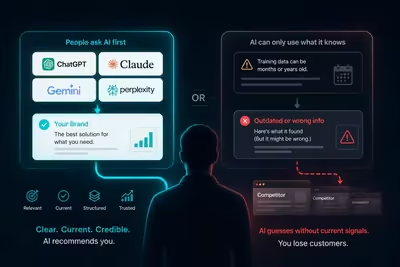
When people want the best product, the right service, or an answer, they ask ChatGPT, Claude, Gemini or Perplexity before they visit a website.

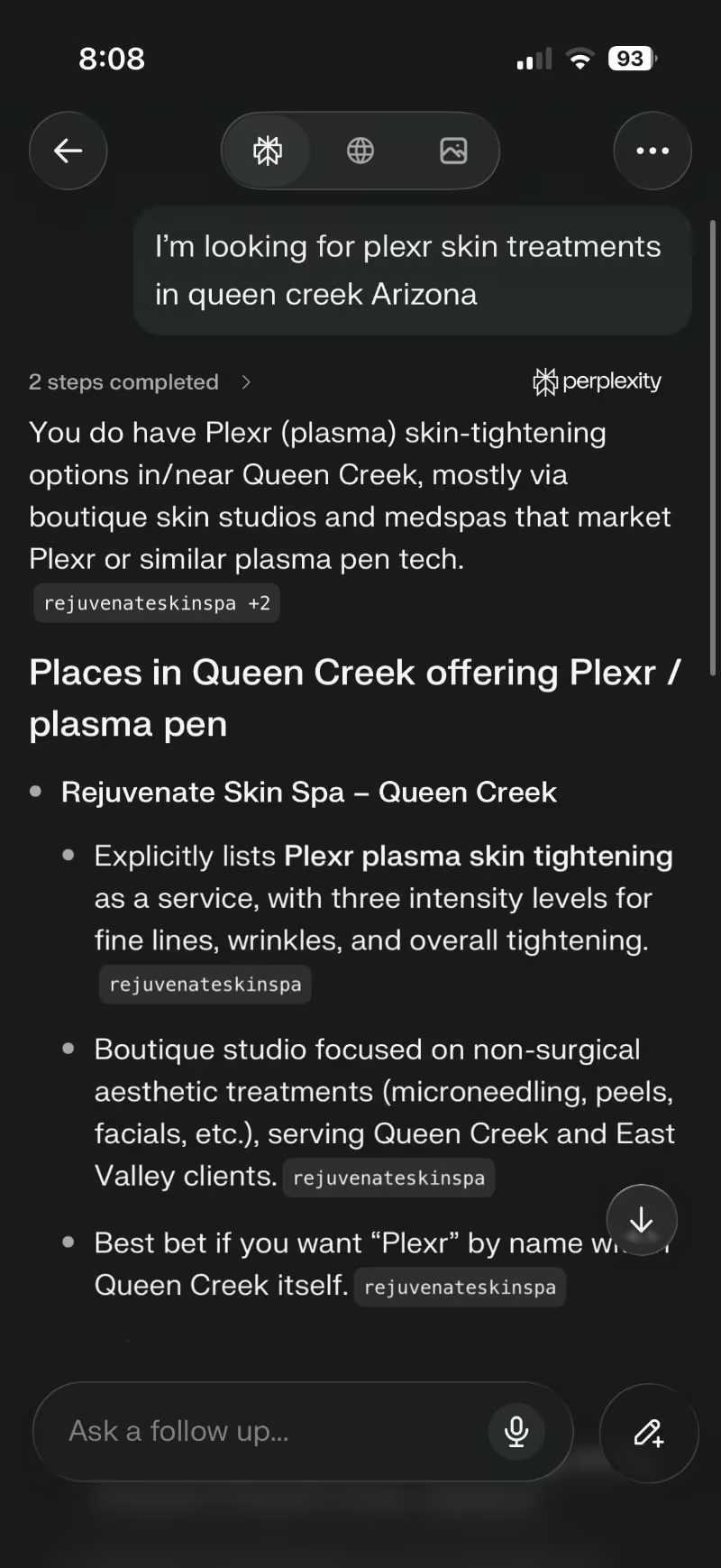
AI systems learned from training data that can be months or years old. Without clear, current, structured signals from you, they guess, and often guess wrong, sending people to competitors or giving outdated information.
AI research and discovery process
THE SOLUTION

The AI Readiness Kit

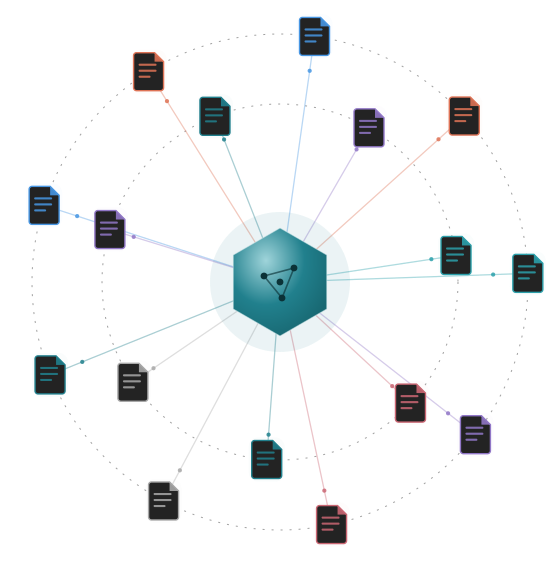
16 files you place at the root of your website. They speak the language AI systems already understand, so your brand shows up accurately, completely, and on your terms.

Control Access
Tell every major AI crawler exactly what they can and cannot see.
Give the Full Story
Cheat sheets and deep dives written for LLMs and RAG pipelines.
Map Intent
Route real user questions straight to the best page on your site.
Set the Rules
Publish clear policies on training data use and AI transparency.
COMPLETE REFERENCE

The 16 Files

Identity & Permissions
The files that introduce your brand and control which AI systems get access
robots.txt
robots.txt
Critical
Controls who gets in and where they can go. One of the oldest files on the web, upgraded for AI. Tells every crawler and AI bot exactly which sections of your site they can access, and points them toward your AI-specific readiness files.
View details
ai.txt
ai.txt
Critical
Purpose-built for the age of AI. Your brand's complete introduction to every AI system. Contains company identity, what you sell, what you are known for, authoritative topics, and explicit rules for what AI systems can and cannot do with your content.
View details
Content Files
The files that give AI the full story about your site in readable text
llms.txt
llms.txt
Critical
A quick-read summary of your entire website, written specifically for large language models. Follows the llmstxt.org standard. Company name, short description, organized sections for every part of your site with direct links, and the most common questions people ask.
View details
llms-full.txt
llms-full.txt
Critical
The extended edition. Rich context, detailed Q&A sections, full category explanations, and everything an AI system needs to speak knowledgeably. llms.txt is the back-of-book summary; llms-full.txt is the complete book.
View details
Map & Navigation
The files that help AI navigate your site structure efficiently
ai-sitemap.xml
ai-sitemap.xml
High
An upgraded sitemap with AI-specific directions. Beyond standard URL + lastmod, every entry includes content-type labels, topic descriptions, and plain-English one-sentence summaries so AI knows exactly what each page contains before visiting.
View details
sitemap.md
sitemap.md
Medium
A plain-text, markdown-formatted overview of your entire website structure. No XML, no JSON, just organized sections, links, and conversational descriptions. The most approachable file for both humans and AI.
View details
Intelligence Files
The files that give AI deep knowledge of your entities, products, and user intents
ai-entities.json
ai-entities.json
High
A structured catalog of every significant element: product categories, subcategories, services, brands, and key concepts. Each entity has name, type, description, related URLs, and connections. Powers the knowledge graphs AI builds internally.
View details
ai-intent.json
ai-intent.json
High
A lookup table mapping real user questions (the exact things people type into AI assistants) to the single best page on your website to answer them. Transforms AI from a general information source into a precise navigation tool.
View details
ai-schema.json
ai-schema.json
High
Uses the Schema.org standard (Google, Microsoft, Yahoo, Yandex) in a machine-readable JSON-LD format. Defines organization type, founding date, address, social profiles, contact info, and site search functionality with zero ambiguity.
View details
Research Files
The files that power AI research and retrieval pipelines
rag-index.json
rag-index.json
High
A pre-built index designed for Retrieval-Augmented Generation (RAG). A JSON array of records (one per major page/section) containing URL, title, and topics covered. AI systems can load this directly into LlamaIndex, LangChain, Pinecone, Weaviate, etc.
View details
rag-index.jsonl
rag-index.jsonl
High
The identical content to rag-index.json, but in JSON Lines (newline-delimited) format. Preferred by large-scale ML pipelines, OpenAI fine-tuning, and streaming vector DB ingestion because records can be processed one-by-one without loading the entire file into memory.
View details
Policy Files
The files that set the rules for how AI can use your content
ai-disclosure.txt
ai-disclosure.txt
Medium
Your public statement about how your organization uses AI in products, operations, and customer interactions. Like a privacy policy for the AI era. Answers: Is AI generating content? Making decisions? Can users reach a real person?
View details
training-data-policy.txt
Medium
Your formal published position on whether AI companies can use your content to train their models. Clearly states what is permitted (e.g. real-time RAG) vs. what requires a license (commercial model training). Protects your organization legally.
View details
Operations Files
The files that help your team deploy and maintain everything
structured-data-guide.md
Low
The most technical file, written for your development team, not AI. A comprehensive step-by-step guide with ready-to-use JSON-LD examples for every major page type: Product, LocalBusiness, BlogPosting, Event, etc. Powers rich results and page-level understanding.
View details
manifest.json
manifest.json
Medium
The single source of truth for your entire AI readiness implementation. Lists every file deployed, what it does, its URL, format, intended audience, and update frequency. Includes a summary scorecard. Lets anyone instantly audit your readiness status.
View details
deployment-checklist.md
Internal
The practical playbook your team follows to move from files on a computer to files correctly serving live traffic. Organized in clear phases with verification steps for each critical file. Nothing is skipped, forgotten, or misconfigured.
View details
THE FILES

What makes a site AI-ready?

These files across 7 categories are what determine whether AI systems can accurately understand and recommend your website.

These are the files that determine how ready your site is for AI discovery.
Full deployment of critical + high priority files typically yields 85%+ readiness
Identity & Permissions
robots.txt(robots.txt)
Critical
ai.txt(ai.txt)
Critical
Content Files
llms.txt(llms.txt)
Critical
llms-full.txt(llms-full.txt)
Critical
Map & Navigation
ai-sitemap.xml(ai-sitemap.xml)
High
sitemap.md(sitemap.md)
Medium
Intelligence Files
ai-entities.json(ai-entities.json)
High
ai-intent.json(ai-intent.json)
High
ai-schema.json(ai-schema.json)
High
Research Files
rag-index.json(rag-index.json)
High
rag-index.jsonl(rag-index.jsonl)
High
Policy Files
ai-disclosure.txt(ai-disclosure.txt)
Medium
training-data-policy.txt(training-data-policy.txt)
Medium
Operations Files
structured-data-guide.md(structured-data-guide.md)
Low
manifest.json(manifest.json)
Medium
deployment-checklist.md(deployment-checklist.md)
Internal

Download the AI Readiness Skill above and use it in your favorite tool to generate AI visibility files, docs, and implementation assets for your website.

FOUR PHASES

How to become AI-ready

01
Start with Critical

Deploy robots.txt, ai.txt, llms.txt, and llms-full.txt first. These deliver the biggest immediate impact.

02
Map Your Site

Add ai-sitemap.xml and the human-readable sitemap.md so AI systems can discover and understand every page efficiently.

03
Add Intelligence

Create the JSON intelligence files (entities, intent, schema) and the RAG research indexes. This is where precision happens.

04
Publish Policies & Maintain

Add disclosure and training policies. Use the manifest and checklist to keep everything current and auditable.

Everything you need is in the guide.

The original plain-English reference with real-world analogies and exact implementation recommendations for each file.

Download the full guide (PDF)

The best time to become AI-ready was before AI became the default search interface.

THE SECOND BEST TIME IS NOW

Your website was designed for humans.These files redesign it for AI.

As AI becomes the first stop for discovery, being AI-ready is how you stay visible, accurate, and in control.

Use it in your favorite tool to generate a complete set of AI visibility files.
FAQ

Common questions about AI readiness

Plain-English answers from the AI Readiness Guide, organized by the same 7 categories as the kit.

Getting Started

The basics of AI readiness and why it matters for every website.

What are AI Readiness Files?
They are structured files you deploy at the root of your website to tell AI systems exactly who you are, what you offer, and where to send people. They speak a format AI already understands, so assistants stop guessing about your brand based on old training data.
Why does AI readiness matter now?
When someone wants a product recommendation, a service provider, or a straight answer, they often ask ChatGPT, Claude, Gemini, or Perplexity before they visit a website. If you are not giving those systems clear, current signals, they guess. And they often guess wrong.
How many files are in the kit?
The kit includes 17 purpose-built files across 7 categories: Identity & Permissions, Content Files, Map & Navigation, Intelligence Files, Research Files, Policy Files, and Operations Files. Each one helps AI understand and represent your site more accurately.
Where should I start?
Start with the critical files: robots.txt, ai.txt, llms.txt, and llms-full.txt. They deliver the biggest immediate impact and are what most AI systems look for first. Then add sitemaps, intelligence JSON files, policies, and operational files using the deployment checklist.

Identity & Permissions

How you introduce your brand and control AI crawler access.

What does robots.txt do for AI?
robots.txt sits at the front door of your website and tells automated visitors (search engines, AI bots, and scrapers) which sections they can access. For AI readiness, it includes instructions for major crawlers like GPTBot and ClaudeBot, pointing them toward your llms.txt and ai-sitemap.xml while keeping checkout, login, and admin pages off limits.
What is ai.txt?
ai.txt is your brand's introduction to every AI system on the internet. Where robots.txt controls access, ai.txt goes further. It covers what you sell, what you are known for, your authoritative topics, and the rules for what AI systems can and cannot do with your content.
How is ai.txt different from robots.txt?
robots.txt controls access: which pages bots can crawl. ai.txt controls identity: who you are, what you offer, and your ground rules for AI use of your content. Think of robots.txt as the doorman and ai.txt as the briefing document you hand a journalist before an interview.

Content & Navigation

Files that give AI the full story and a map of your site.

What is llms.txt?
llms.txt is a structured text file built for large language models. It gives AI a quick map of your website: company name, description, organized sections with direct links, and the most common questions your site answers. It follows the llmstxt.org standard used by ChatGPT, Claude, Gemini, and Perplexity.
What's the difference between llms.txt and llms-full.txt?
llms.txt is the cheat sheet: a quick summary an AI can scan in seconds. llms-full.txt is the deep dive with rich descriptions, detailed Q&A, and full category explanations. If llms.txt is a Wikipedia summary, llms-full.txt is the full article.
Why do I need an ai-sitemap.xml?
A regular sitemap lists pages and timestamps. The ai-sitemap adds what each page is about, its content type, and a plain-English summary. It is the difference between a paper road map and GPS with points of interest. AI crawlers can understand pages without fetching and parsing each one individually.

Intelligence & Research

Structured data that powers accurate AI answers and retrieval.

What is ai-intent.json?
ai-intent.json maps real user questions (the things people type into AI assistants) to the best page on your website to answer each one. Without it, AI guesses which page to recommend. With it, you give AI a direct URL for every common query.
What are ai-entities.json and ai-schema.json for?
ai-entities.json is a structured catalog of the important parts of your site: products, categories, services, and key concepts. It powers AI knowledge graphs. ai-schema.json uses the Schema.org standard to describe your organization in machine-readable format so search engines and AI systems can identify you without ambiguity.
What are the RAG index files?
rag-index.json and rag-index.jsonl are ready-made indexes of your site built for AI research and retrieval pipelines. When a user asks a question, AI first pulls the most relevant documents from this index before generating an answer, which keeps responses grounded in your actual content.

Policies & Maintenance

Rules for AI use of your content and keeping files current.

What is a training data policy?
training-data-policy.txt sets formal rules for how AI companies can use your content, including model training, RAG indexing, and commercial use. It answers a practical question every brand should decide upfront: what are others allowed to do with your work?
What is ai-disclosure.txt?
ai-disclosure.txt is a public transparency report explaining how your organization uses AI, whether for content generation, recommendations, or customer interactions. It builds trust by answering those questions before someone has to ask.
How often should I update my AI readiness files?
It depends on the file. Update llms.txt and sitemaps monthly or when your site structure changes. Refresh ai.txt and llms-full.txt quarterly or when products change. Review policy files annually. The manifest.json file lists recommended update frequencies for every file in the kit.